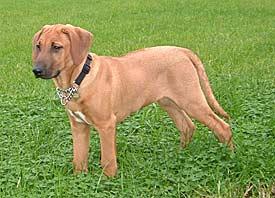
Rhodesian Ridgeback
African lion hunter — quiet, powerful, and famously independent thinker.
Traits at a glance
Cost calculator
Training tips for a Rhodesian Ridgeback
Practical, breed-specific advice tuned to a Rhodesian Ridgeback's temperament, energy and trainability.
House-training Consistency
Establish a strict toilet schedule and supervise closely indoors; if you catch accidents in progress, use a firm verbal interrupter and immediately take outside to finish, then calmly praise completion in the right spot.
Early Socialisation Essential
Expose your Ridgeback to diverse people, dogs, and environments before 16 weeks to counter their natural reserve; pair novel experiences with calm handling rather than over-excitement to build confident neutrality.
Exercise and Mental Work
Provide daily vigorous off-lead running in secure areas plus scent work or tracking games to satisfy their hound instincts; a tired Ridgeback with a job is far more biddable indoors.
Managing Stubborn Independence
When your Ridgeback ignores known commands, use a well-timed leash prompt or spatial pressure to guide compliance, then immediately release pressure and acknowledge the correct response—they respect fairness, not nagging.
Calm, Firm Leadership
Train with clear boundaries and consistent consequences suited to their dignified temperament; avoid harsh repetition but don't negotiate—Ridgebacks respond to handlers who are confident, patient, and mean what they say.
Training guides for a Rhodesian Ridgeback
Expert-written guides picked for a Rhodesian Ridgeback's temperament and needs.
How dogs actually learn: the four quadrants explained
Positive reinforcement, negative reinforcement, and everything in between — a clear, honest look at operant conditioning and when each tool is the right call.
Building a rock-solid recall
A reliable come-when-called can save your dog's life. Here's how to build one that holds up around real distractions.
Loose-lead walking: stop the pulling for good
Why your dog pulls, and a step-by-step plan using clear reinforcement to build a relaxed, no-tension walk.
Health & nutrition for a Rhodesian Ridgeback
What to watch for, how to feed, and how to keep a Rhodesian Ridgeback in top shape — tuned to this breed's size and build.
Common health concerns
- •Rhodesian Ridgebacks are genetically prone to dermoid sinus, a congenital neural tube defect that appears as a tubular indentation along the spine and requires surgical removal if present.
- •Hip and elbow dysplasia are common in this large breed, so monitor for lameness, reluctance to jump, or stiffness after rest, particularly as they mature.
- •Hypothyroidism can develop in Ridgebacks, presenting as weight gain, lethargy, and coat changes despite proper feeding and exercise.
- •Bloat (gastric dilatation-volvulus) is a life-threatening risk in deep-chested large breeds like Ridgebacks, so watch for restlessness, unproductive retching, and abdominal distension requiring immediate veterinary attention.
Feeding & nutrition
- •Feed a biologically-appropriate raw diet consisting of 70-80% raw muscle meat (beef, kangaroo, lamb), 10% raw meaty bones (chicken frames, lamb necks), 5% liver, 5% other organs, and occasional eggs or oily fish to fuel this powerful 70-85 lb athlete.
- •Portion approximately 2-3% of body weight daily (roughly 1.4-2.5 kg for an adult Ridgeback), split into two meals to reduce bloat risk and support their high energy needs and lean muscle mass.
- •Raw meaty bones provide natural teeth cleaning and mental stimulation for this independent thinker, while species-appropriate raw food supports joint health and reduces inflammation compared to processed carbohydrates.
- •If convenience absolutely demands it, choose a high-protein, grain-free kibble as a fallback, but understand that processed food lacks the enzymes, moisture, and bioavailable nutrients that raw feeding provides for optimal health in this athletic hound.
Exercise & weight
- •Provide at least 60-90 minutes of daily vigorous exercise including long runs, hiking, or off-lead galloping in secure areas to satisfy this athletic breed's high energy and working heritage.
- •Incorporate mentally stimulating activities like scent work or tracking games to engage their hound instincts and prevent boredom-related destructive behaviour.
- •Avoid repetitive high-impact exercise (jumping, agility) during the growth phase (up to 18 months) to protect developing joints and reduce dysplasia risk.
- •Maintain consistent daily exercise throughout their life to prevent obesity, which exacerbates joint issues and reduces their typical 10-12 year lifespan.
Educational guidance only — not veterinary advice. Always consult a licensed vet for your dog's specific health needs.
Ready to meet a Rhodesian Ridgeback?
Search animal shelters and rescues across Australia — and consider bringing a certified trainer to your first meet-and-greet.