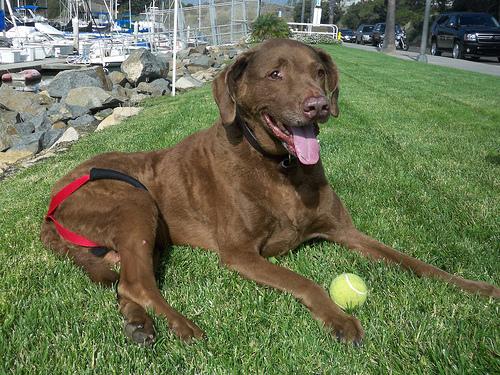
Chesapeake Bay Retriever
Waterfowl-hunting workhorse with an oily wave-proof coat — serious dog for serious owners.
Traits at a glance
Cost calculator
Training tips for a Chesapeake Bay Retriever
Practical, breed-specific advice tuned to a Chesapeake Bay Retriever's temperament, energy and trainability.
House-Training Foundations
Establish a strict routine with outdoor trips after meals and sleep, and use a firm 'no' if you catch accidents in progress, then immediately redirect outside. Their sensitivity means they'll quickly connect consequences with actions when timing is precise.
Early Broad Socialisation
Expose your Chessie to diverse people, dogs, and environments before 16 weeks, as they can become territorial or aloof without it. Correct any early guarding or standoffish behaviour with a leash check and redirect to neutral engagement.
Exercise and Work
Provide daily swimming, retrieving drills, or scent work to satisfy their working drive—boredom leads to destructive behaviour. A tired Chesapeake with a job is a manageable Chesapeake.
Managing Strong-Willed Independence
This breed will test boundaries, so establish clear rules and follow through with calm, immediate corrections when they ignore known commands. Consistency and fairness earn their respect far more than repetition alone.
Balanced Leadership Approach
Train with clear markers for correct behaviour and fair consequences for non-compliance, as Chessies respond best to handlers who communicate like a competent pack leader. Their sensitivity means corrections should be well-timed but never harsh.
Training guides for a Chesapeake Bay Retriever
Expert-written guides picked for a Chesapeake Bay Retriever's temperament and needs.
How dogs actually learn: the four quadrants explained
Positive reinforcement, negative reinforcement, and everything in between — a clear, honest look at operant conditioning and when each tool is the right call.
Building a rock-solid recall
A reliable come-when-called can save your dog's life. Here's how to build one that holds up around real distractions.
Loose-lead walking: stop the pulling for good
Why your dog pulls, and a step-by-step plan using clear reinforcement to build a relaxed, no-tension walk.
Health & nutrition for a Chesapeake Bay Retriever
What to watch for, how to feed, and how to keep a Chesapeake Bay Retriever in top shape — tuned to this breed's size and build.
Common health concerns
- •Chesapeake Bay Retrievers are genetically prone to hip dysplasia and elbow dysplasia, so monitor for limping, difficulty rising, or reluctance to jump and maintain a lean body condition to reduce joint stress.
- •Progressive retinal atrophy (PRA) and other hereditary eye diseases occur in this breed, requiring annual ophthalmologist examinations to catch early vision decline.
- •Hypothyroidism is common in Chessies, presenting as weight gain, lethargy, and coat quality changes, so watch for unexplained energy drops or skin issues.
- •Gastric dilatation-volvulus (bloat) is a life-threatening risk in deep-chested large breeds like this one, so feed multiple smaller meals and restrict vigorous activity immediately after eating.
Feeding & nutrition
- •Feed a biologically-appropriate raw diet built on 70-80% raw muscle meat (beef, lamb, duck, venison), 10% raw meaty bones (chicken frames, turkey necks, lamb ribs) for dental health and joint support, and 5-10% organ meat (liver, kidney) to provide essential vitamins for thyroid and eye health.
- •A 55-80 lb active Chesapeake typically requires 1,200-1,800 calories daily (roughly 2-3% of body weight in raw food), adjusted based on workload, age, and body condition to maintain lean muscle without excess weight on joints.
- •Raw oily fish (sardines, mackerel) 2-3 times weekly provides omega-3 fatty acids critical for maintaining the breed's water-resistant coat, reducing inflammation, and supporting joint and eye health.
- •If raw feeding is temporarily impractical, select a high-protein, low-carbohydrate grain-free kibble as a backup, but understand that processed food lacks the enzymes, moisture, and bioavailable nutrients this athletic working breed thrives on.
Exercise & weight
- •Chesapeake Bay Retrievers require 60-90 minutes of vigorous daily exercise including swimming, retrieval work, or long off-lead runs to satisfy their working drive and prevent destructive boredom behaviours.
- •Water-based activities (dock diving, retrieving from water, swimming) are ideal for this breed's physical and mental health while being low-impact on hips and elbows.
- •Incorporate scent work, obedience training, or field trials into exercise routines to engage their intelligent, task-oriented temperament and prevent anxiety or stubbornness.
- •Avoid high-impact repetitive activities (excessive ball throwing, hard jumping) especially in dogs under 18 months or those with joint concerns, as this breed's heavy build increases orthopaedic risk.
Educational guidance only — not veterinary advice. Always consult a licensed vet for your dog's specific health needs.
Ready to meet a Chesapeake Bay Retriever?
Search animal shelters and rescues across Australia — and consider bringing a certified trainer to your first meet-and-greet.